
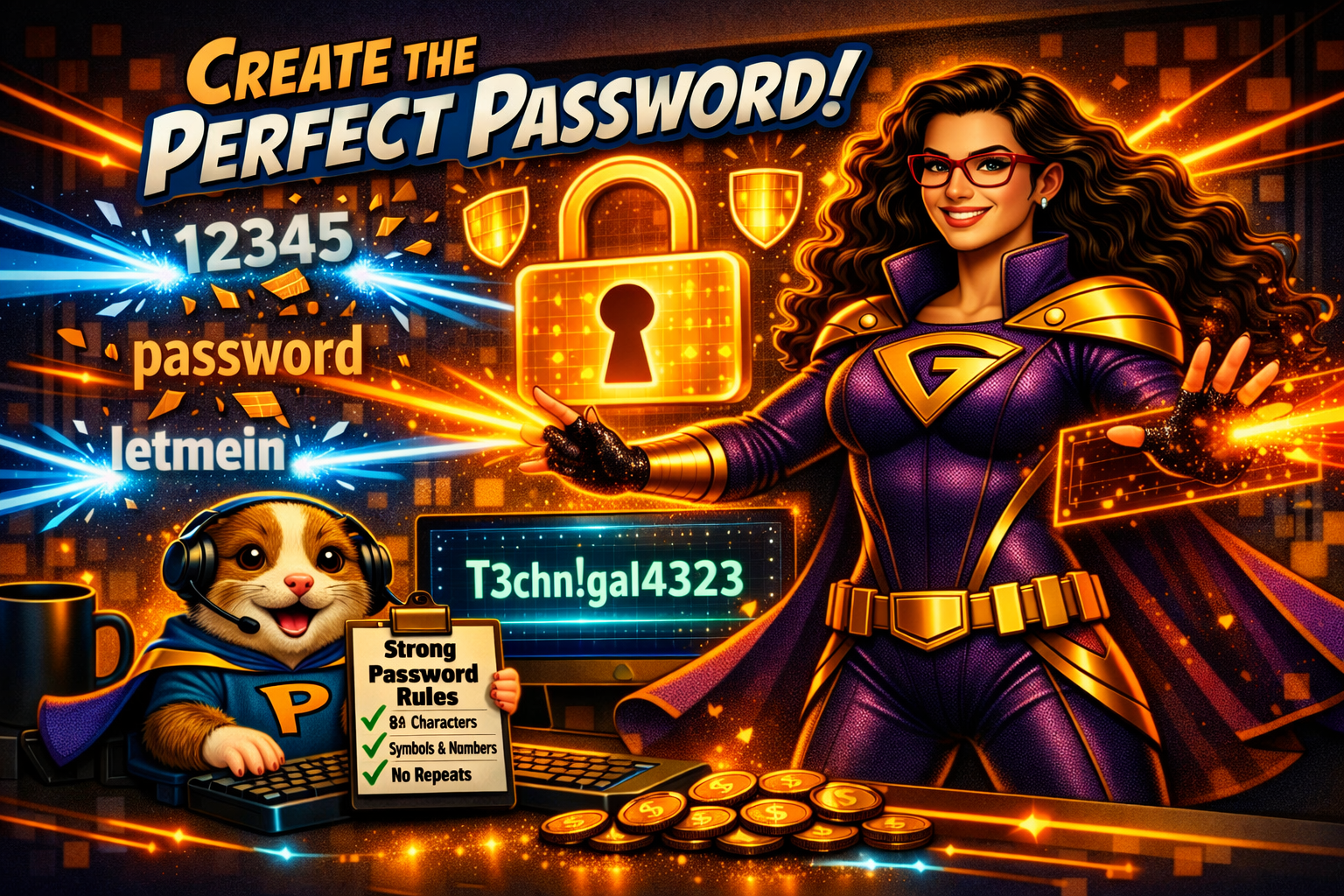
Another day, another tech mystery…
Mission Brief
Pixel and I were reviewing security logs when he made an observation:
“I think humans believe that all passwords are created equally.”
He held up a sticky note with the word password123 written on it.
I sighed. I’d seen that password hundreds of times before.
Protecting your password isn’t just about keeping it off sticky notes or refusing to hand it out. Some of the biggest security risks come from passwords that are reused, predictable, or easy to guess.
And that’s why many systems require complex passwords — the kind that change every few months and require random lettters and numbers that make no sense to the human mind.
What’s actually going on?
Complex passwords exist for a reason:
- Simple passwords are easy to break.
- Machines can guess dictionary words in minutes.
- Attackers can try thousands of combinations in seconds using bots or AI.
And personal information? That’s the first thing they test.
Pixel shuddered.
“If someone guessed my password, they’d have access to my snack vault.”
Exactly.
Let’s break down what makes a password strong — and what makes it dangerously weak.
The Rescue Plan
What Makes a Password Strong?
1. It’s Unique
Some systems won’t let you reuse a password within the same year. Others reject passwords that are too similar to previous ones or that include personal details (like your name or birthday).
2. It Uses Uppercase, Lowercase, Numbers, and Symbols
Most systems specify their requirements.If your password is rejected, re‑read the instructions — they’re your roadmap.
3. It’s Long
Eight characters is the bare minimum. More characters = more time for a malicious actor to decrypt it. Pixel calls this “The Longer, The Stronger Rule.”
What Makes a Password Easy to Guess?
1. Popular Phrases
Examples include:
-
- password
- Fall2018
- 1234567
If it’s on a “Most Common Passwords” list, avoid it like a villain in the Digital District.
2. Personal Information
Your child’s name.
Your dog’s name.
Your favorite sports team.
Your birthday.
Your nickname.
If it’s on your social media profile, don’t use it.
3. Dictionary Words
Attackers use something called a Dictionary Attack — a machine‑powered assault that tries every word in the dictionary until it cracks your password.
It doesn’t take long.
Pixel imagines a tiny villain flipping through a dictionary, but in reality, it’s a machine doing thousands of guesses per second.
Why is this important?
The wisest companies require frequent password changes, complex passwords, and lockouts after failed attempts — not to annoy you, but to protect you.
A lockout after three failed attempts isn’t punishment. It’s a shield. You wouldn’t secure your home with a flimsy padlock.
Your digital life deserves stronger protection.
This is how you save the world—one tech issue at a time.