
Another day, another tech issue…
Mission Brief
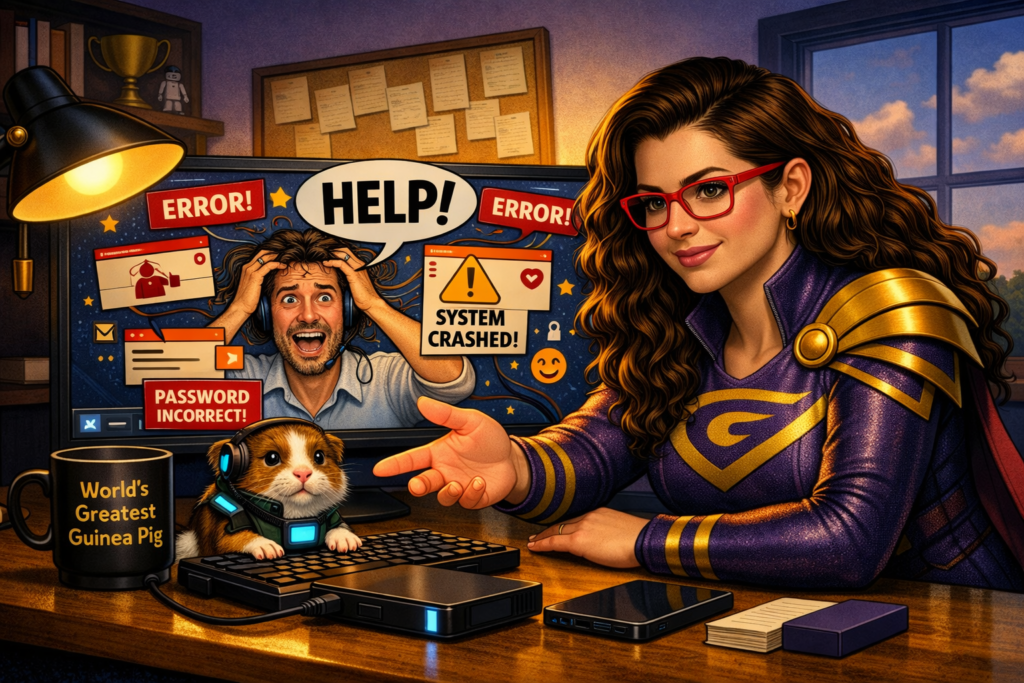
Pixel and I were sorting through helpdesk tickets when we saw it again — the shortest, most dramatic cry for assistance in the Digital District:
“Help!”
Sometimes it appears in the subject line. Sometimes it’s the entire message. Sometimes it’s accompanied by absolutely no explanation at all.
Pixel tilts his head.
“Help with… what? Snacks? A dragon? A printer?”
Without details, even a tech‑hero is left trying to read minds — and mind‑reading is not one of my superpowers.
What’s actually going on?
Text‑based communication has changed the way people express themselves.
Grammar has morphed into “text speak,” where:
- emojis replace tone
- acronyms replace sentences
- exclamation points replace emotion
- long messages are frowned upon
- one‑word responses are common
In this new world, “Help!” feels fast, urgent, and expressive.
But here’s the problem: Without verbal cues or context, the tech‑hero has no idea what’s actually wrong.
When I see “Help!”, my brain briefly plays the Beatles song (Pixel sings backup).
But in real life, vague cries for help can trigger a “bystander effect” — people see it, but skip over it, assuming someone else will handle it. And honestly? I often do skip it — because I have no clue whether I’m the right hero for the job.
If you don’t tell me what’s broken, I can’t fix it.
The Rescue Plan
To help your tech‑hero help you, include the classic journalism questions — the ones we learned back when grammar was still a thing:
1. Who are you?
Your name, department, or role helps us understand your setup.
2. What exactly is wrong?
The more specific, the better:
“My screen is black.”
“My password won’t work.”
“My printer is eating paper.”
3. When did it start happening?
Did it break today? Has it been glitching all week?
4. Where are you (or your device)?
Location matters — especially for in‑person troubleshooting.
5. Why is this an emergency?
Are you locked out? Is a deadline looming? Is Pixel panicking? (This one is optional.)
Answering these questions helps you think through the issue and gives your tech‑hero everything needed to swoop in and save the day.
Why is this important?
Clear communication prevents delays, reduces frustration, and ensures your tech‑hero can respond quickly and accurately. A one‑word SOS may feel efficient, but details are what actually lead to solutions.
This is how you save the world – one tech issue at a time.